Building blocks and eco-boards
Ramani in Kenya shreds used cartons into boards and blocks for housing, school desks, kitchen fittings and formwork. The blocks were reported at about half the cost of conventional stone construction.
The carton is not finished when the water is.Used beverage cartons are already becoming roof sheets, wall panels, building boards, furniture, decking, paper products and more. This is the documented record, including what the evidence does not support.
The paper fibre and the polyethylene-aluminium fraction can follow different paths. These documented programmes show commercial products, building applications and community uses already in operation.
Ramani in Kenya shreds used cartons into boards and blocks for housing, school desks, kitchen fittings and formwork. The blocks were reported at about half the cost of conventional stone construction.
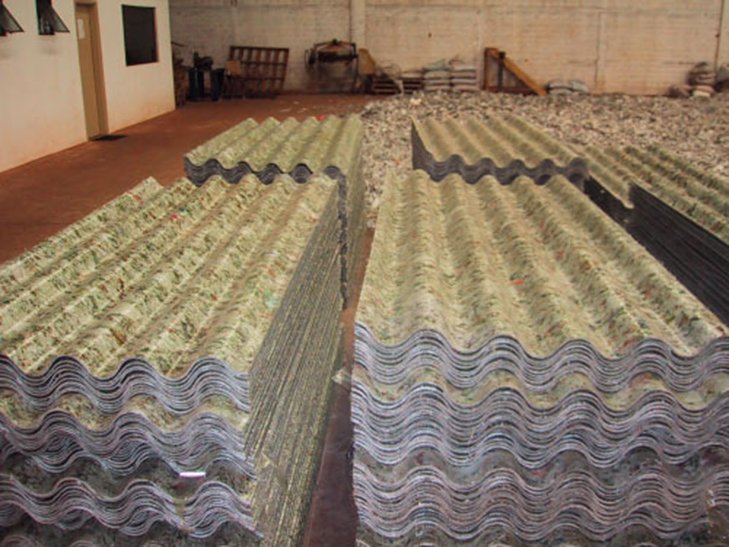
Documented programmes include IBAPLAC tiles in Brazil, ECOPeal roofing sheets in Malaysia, Poly Roof sheets in Indonesia and Green Shelter roofing in Thailand.
Feplo lists wall and ceiling uses for its waterproof boards. saveBOARD panels are specified for internal walls and ceilings. Kenya's Ramani also makes ceiling boards.
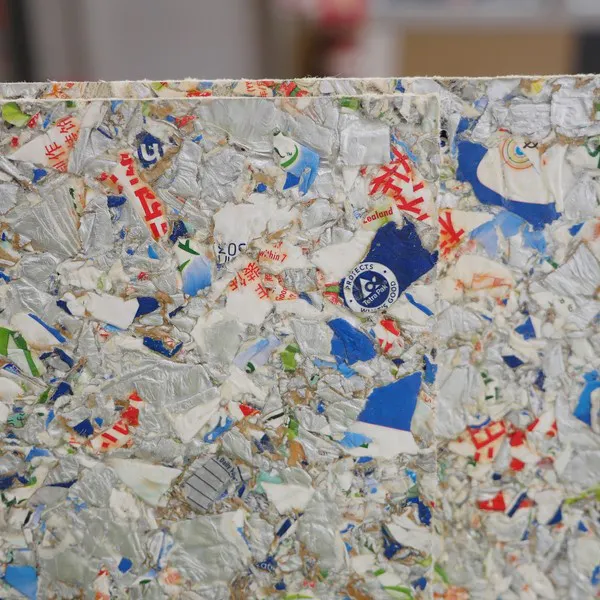
New Zealand's saveBOARD makes 1200 × 2400 mm panels in 6 to 30 mm thicknesses. Each board uses more than 500 cartons and can replace plywood, particle board or plasterboard in listed applications.
Documented uses include Mater's press-moulded Conscious Chair, Kenya school desks, Pakistan outdoor furniture and Thai street furniture. Examples supported solely by Tetra Pak reporting are explicitly labeled as maker-sourced.
NZ Plastic Products and Tetra Pak Oceania documented a South Auckland route for turning recovered carton plastic and aluminium, including caps and straws, into decking timber substitute.
ALFAPAK 3D is a weather-resistant filament made mostly from recycled PolyAl for conventional 3D printers, developed by Ecorevive and Maip Compounding in Italy.
PolyAl has been used for toys, stationery, work tools, storage boxes, cable drums, reels and bobbins. Italian EcoAllene and Sweden's Greenology programmes are named examples.
Recovered fibres become cardboard, tissue, office paper, kraft paper, newsprint, notebooks, bags and moulded food-service items. Colombia's Proplanet and Poland's Stora Enso hub are named examples.
A 2022 Colombian prototype used more than 200 PolyAl panels sourced from more than 3 million post-consumer cartons across roughly 220 m² of interior and exterior area.
Tetra Pak programme pages list pallets and crates as possible PolyAl products, but no named independent manufacturer appears in the evidence reviewed. The category is technically reported, not independently verified at maker level.
In Piracicaba, a plasma process separates recovered PolyAl into paraffin and pure aluminium ingots. The plant was designed for 8,000 tonnes of PolyAl per year, equal to roughly 32,000 tonnes of aseptic packaging.
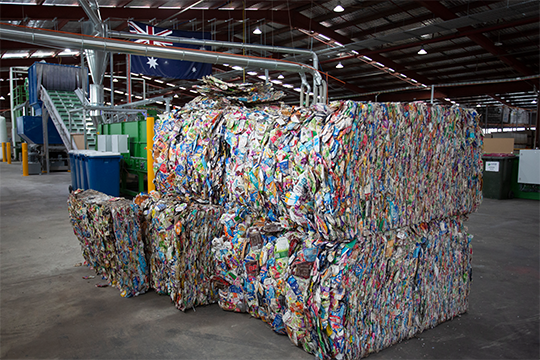
The visual proof is not hypothetical. saveBOARD receives used beverage cartons and presses them into panels for building applications. Similar whole-carton pressing routes operate in Serbia and Kenya.
in one saveBOARD panel, according to New Zealand reporting.
planned waste diversion at the Te Rapa plant when it opened.
in direct pressing systems such as Feplo. Heat activates the carton polymer as the binder.
Sources: ArchitectureNow and EU Circular Economy Platform.
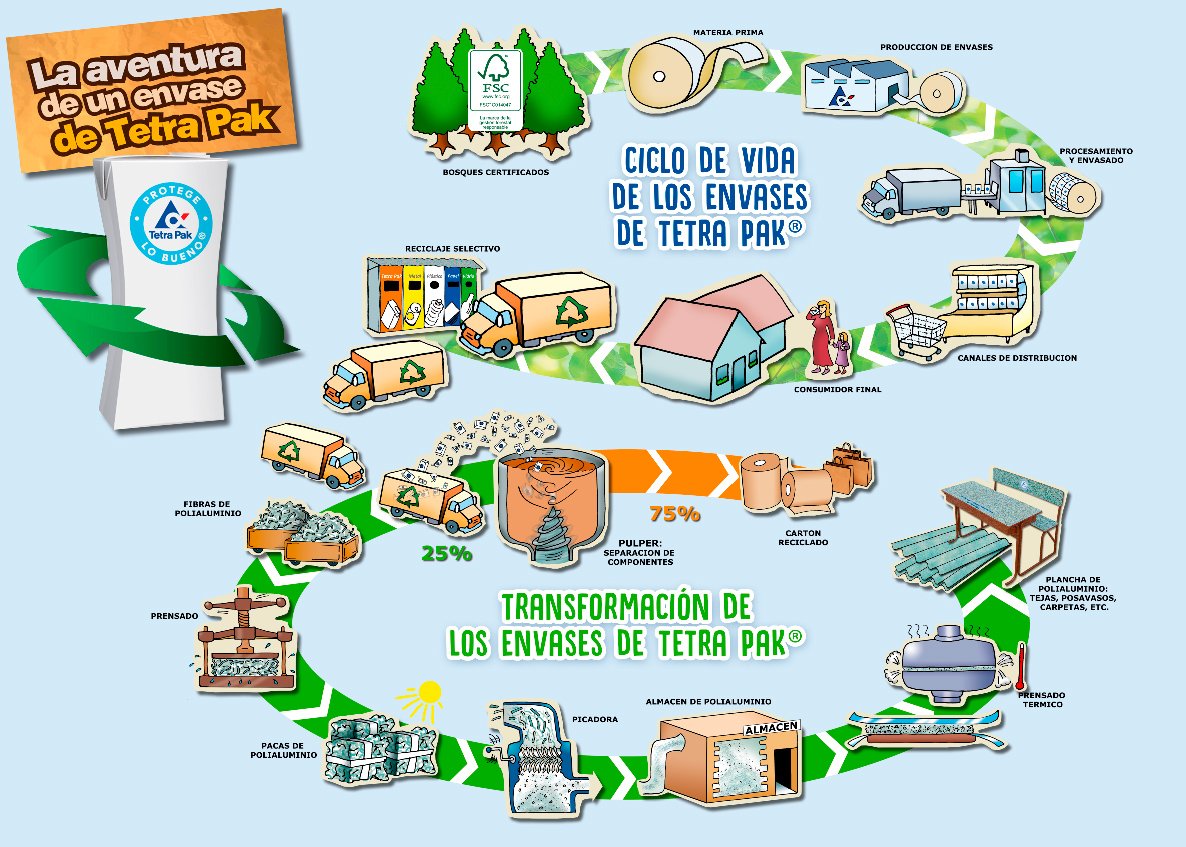
Aseptic cartons are layered materials. Most are roughly 70 to 75 percent paperboard, 20 to 25 percent polyethylene and about 5 percent aluminium. Recyclers either separate those fractions or press the whole shredded carton into board.
Used cartons are collected and prepared as a feedstock. In NYC, they belong with metal, glass and plastic, not with mixed paper.
A water-filled industrial pulper separates the paper fibre from the PolyAl barrier layers.
The cleaned fibre becomes paper reels and then paperboard, cardboard, tissue, kraft paper, newsprint or moulded pulp.
The polyethylene and aluminium fraction can be pressed, chopped, granulated, pelletised or compounded into panels and moulded goods.
Some recyclers shred and heat-press complete cartons into building board. The existing polymer layers act as the binder.
Process sources: Tetra Pak recycling journey and Piracicaba plasma separation.
NYC accepts beverage cartons at the curb. No city or state programme turning those collected cartons into building materials appears in the public evidence reviewed. That gap is the opportunity, not proof that a local loop exists.
Set beverage and liquid-food cartons out with the metal, glass, plastic and cartons stream, in a blue-labeled bin or clear bag.
The cartons enter the general municipal stream. Public evidence reviewed here does not establish that New York's cartons become boards, tiles or panels. Global programmes show what a future local pathway could study.
A city buyer can understand the vision without being told a programme already exists. The strongest case separates the beverage purchase, the NYC collection rule and the future recovery partnership into distinct steps.
A9's product claim and the carton-afterlife case should support one another, not blur into a promise that sales automatically create construction materials.
Cartons are accepted curbside. Any institutional programme would still need clean collection, aggregation, transport and a recycling partner.
A pilot would need to identify who owns the material, where it is processed, what product is made and what technical standard governs its use.
Global examples suggest valuable end uses. They do not prove a New York programme will save money until logistics, yield, testing, procurement and disposal costs are modelled.
Independent public agencies and trade sources carry more weight than manufacturer case studies. Where only a Tetra Pak case page was available, this page labels that limitation instead of presenting it as independent confirmation.
Kenya News Agency reports a 1,500-tonne annual recovery target, roughly 30 percent of Kenya's liquid board packaging, across four counties. It reports recycled-carton blocks at about half the cost of conventional stone construction and names additional uses.
Open sourceTetra Pak reports that the CAREton partnership collected more than 4,000 tonnes of used beverage cartons, approximately 283 million packs, and reached more than 1,400 homes through recycled paper and ECOPeal products.
Open maker sourceIndependent New Zealand architecture media documents the Te Rapa plant, 4,000-tonne annual diversion plan and panels containing more than 500 cartons. A city council source documents the collection network.
ArchitectureNow · Porirua City CouncilEnvapack reports a 2022 housing prototype made with more than 200 PolyAl panels from more than 3 million cartons. A peer-reviewed MDPI paper also cites the project.
Envapack · MDPI BuildingsPackaging Gateway documents Piracicaba's plasma separation plant. A separate Brazilian source documents IBAPLAC roof tiles supplied to the housing NGO TETO. The sources do not place IBAPLAC in Piracicaba.
Packaging Gateway · Recicla SampaDSNY and NYC 311 direct residents to recycle beverage cartons with metal, glass, plastic and cartons. DSNY explicitly says not to place them with mixed paper and cardboard.
DSNY cartons guidance · NYC 311The material system is layered, and so is the evidence. These answers separate what is documented, what New York does today and what a future local loop would require.
Mostly paperboard, about 70 to 75 percent, with thin layers of plastic and aluminum that keep the contents fresh without refrigeration. Those layers are why cartons need specialized recycling, and why the recovered materials have their own second lives.
The fiber route recovers the paperboard for recycled board, paper, and tissue products. The PolyAl route recovers the plastic and aluminum mix, which gets pressed and molded into building boards, roof tiles, panels, and molded products. Both routes are documented at commercial scale in multiple countries.
The strongest documented outcomes, with independent or multi-source corroboration, are Kenya's recycled-carton building blocks for affordable housing, New Zealand's saveBOARD construction boards, Serbia's certified waterproof eco-boards, and Colombia's 2022 housing prototype. Figures from company case studies, like Malaysia's CAREton scale, are reported as company or partner figures.
Flood barriers made from used cartons, pothole and road repair uses, and any New York carton-to-building-material program. The full list of what was checked and not found is in the 'What we checked and did not find' section above.
The Department of Sanitation accepts beverage cartons in curbside recycling: blue bin, with metal, glass, and plastic, not with paper. What happens after collection depends on the processing chain. There is no documented New York City program turning cartons into building materials.
Collection at scale, a processing partner for fiber and PolyAl recovery, procurement pathways that accept recycled-content building products, and agency partners willing to pilot it. The documented outcomes on this page show what becomes possible when those systems connect.
No. This is a research reference on what used beverage cartons become around the world. A9's direct choice is the carton over the conventional plastic bottle; the afterlives documented here are industry-wide outcomes.